Making sure that your PaaS offering and the web development framework of your choice agree can be tricky. Learn how to choose the best framework for your enterprise needs.
Regardless
of which PaaS offering you choose, you will also need to choose a web
development framework. The web framework provides the software to
support the development of your web application and to build and deploy
your web-based applications. It’s a compilation of code that allows
developers to build without doing everything from scratch. It’s
important to note that you may be in love with a particular framework,
but it may not be available on your offering.
So,
here’s some information on choosing a web development framework, in
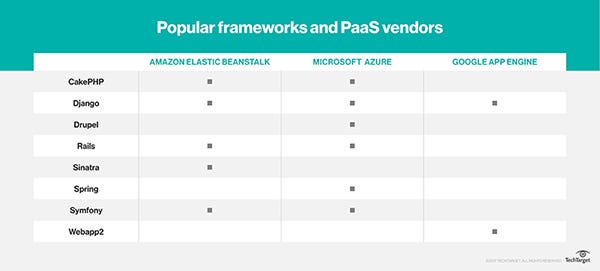
which I drill down to my favorites. The table below provides information
on the more popular frameworks, along with the platform-as-a-service
vendor support from the most widely used PaaS offerings.
Microsoft Azure provides the most web development framework choices, with Beanstalk a close second. The frameworks that we will examine here in more depth — Django and CakePHP — are available on both.
Django
Django
is a free, open source web development framework, which is written in
Python and maintained by the Django Software Foundation. Its goal is to
simplify the creation of complex types of websites that are usually
database-intensive. It was created in 2003 and released in 2005. For
movie lovers, no, it was not named after the movie (one of my favorites,
actually) but rather after guitarist Django Reinhardt.
Let’s look under the covers. Python itself is a very popular language,
and it is rated in the top three for popularity by most polls. One of
the reasons that it is so popular is because of the involvement within
the open source community. If you’re going to develop in Python, Django
is your best bet, because it has such a great support base if you run
into issues. All the vendors that support Django provide detailed
instructions on how to quick deploy and manage Django applications,
without worrying about the underlying infrastructure that manages the
applications. Django is very fast, yet flexible, secure and salable. It
has a strong user authentication system, which is really necessary in
today’s world where cross-site forgeries and clickjacking
are so common. For example, Django contains clickjacking protection by
providing middleware through supported browsers and preventing sites
from being rendered inside a frame.
CakePHP
Let’s look at choosing a web development framework that uses PHP. It is CakePHP. If your preferred programming language is PHP,
this may be the framework that you will use. CakePHP, released in 2005,
is a PHP-based framework that provides flexible database layers, among
other features. It’s open source and modeled after Ruby on Rails. It
also follows the model-view-controller
(MVC) approach and is distributed under the MIT license — a free
software license originated at MIT. The MVC design removes the necessity
of having to combine complex components to design your application
architecture. Similar to Django, there is excellent documentation as far
as how to use CakePHP in either your Azure or Beanstalk implementation.
Content
Find more PRO+ content and other member only offers, here.
- E-Handbook
- Sound application development rests with secure APIs in the cloud
- Buyer’s Handbook
- BaaS vs. MBaaS platforms: Factors to consider in the buying decision
- E-Handbook
- Cloud and DevOps practices help make app development a breeze
PHP or Python?
What
language is better for you: PHP or Python? While PHP is used more as a
server-side scripting language, Python is known more for its simplicity.
PHP is used mainly for websites and was developed for web developers,
while Python is used for many different other applications. PHP is
considered by many to be harder to use, though it can be more robust.
Python has more out-of-the-box support for everything, and most newbies
consider it easier to understand. As far as security is concerned,
Python has a better reputation because its tools are all a part of its
toolbox, while PHP sometimes needs to be handled through the use of
third-party tools. PHP does own the market share, dominating the
internet with over 80% of websites developed in it. However, according
to the Institute of Electrical and Electronics Engineers Inc., the
number one programming language recommended was Python, and PHP was
eighth. Pick your poison or treasure.
The bottom line
How
do you choose a web development framework for your PaaS environment?
Find out if anyone on your team has experience in one and not another.
If not, are you eager to learn another language? Make sure that support
for your web framework is available from your PaaS offering. I recommend
trying at least two to find out what works best for your purposes.
Finally, in my opinion, you can’t go wrong with either Django or
CakePHP.

No comments:
Post a Comment